
By Dr. Andrea Allen
My adventure into 3D printing wildlife began as a personal interest and challenge: to bring TRAFFIC’s 3D shark fin files to life. To date, I have successfully printed all but two, which require a slight size modification to fit my printer—discussed in my last blog post. And last week, Professor Alan Xie dropped off three more painted shark fins.
I guess you can say I’ve caught the 3D printing bug. Initially, the project solely revolved around the TRAFFIC open files for shark fins: ready-to-print, standardized, and perfect for wildlife crime training. But as I dove deeper into learning about the world of 3D specimen modeling, my curiosity grew. What else, I wondered, could I bring to life for classroom demos, exhibit displays, and professional training? Where could I find digital files for the diverse species encountered in wildlife forensics and conservation work?
Discovering MorphoSource: A Goldmine for Digital Natural History
My initial, cursory Google search for “3D printing wildlife files” returned mostly sites offering commercial models for sale. This quickly made me rethink my strategy and refine my search terms to target scientific and educational resources. Searching for “3D printing scientific wildlife databases” led me to a few notable projects, including oVert by the Florida Museum of Natural History and the Smithsonian’s 3D Digitization initiative. However, the most comprehensive resource I discovered—by far—was Morphosource.
MorphoSource is a project hosted by Duke University and open to researchers, teachers, and curious makers worldwide. MorphoSource provides open access to an enormous library of CT scans and 3D surface models representing thousands of species, from fossil hominids and rare reptiles to modern fish and birds. My first visit felt overwhelming, with so many possibilities—and each file packed with scientific detail.
Searching the database, I quickly discovered not only the expected primates and large carnivores, but also extraordinary marine specimens—skates, rays, eels, and a wealth of fish bones. Most files are digitized from museum collections, and the models are often processed to highlight anatomical features valuable in both education and research. Although MorphoSource doesn’t specialize in trade-modified items like carved ivory or processed shark fin products, it has become my go-to platform for anatomical reference and inspiration.
How I Use MorphoSource in My Workflow
I regularly browse MorphoSource to scout for new models to print for wildlife forensics classes and training. When searching the database, if common names don’t yield results, try searching by the species’ scientific name instead—this often provides better results, especially for less well-known or regional species. As someone without a background in zoology, this has been interesting and I’ve learned quite a lot. “Panthera leo” is a lion, and “sus scrofa” is a pig, for instance. Of course, downloading files from MorphoSource sometimes means adapting raw scientific data for 3D printing, including scaling, mesh cleanup, or splitting large models into buildable chunks. But the foundation it provides for authentic, data-driven wildlife education is unparalleled.
Case Study: Printing a White Rhino Horn for Wildlife Forensics
One of my most prized finds on MorphoSource is the digital model of a rhino horn. It feels significant both personally and professionally, not least because rhino horn is one of the most trafficked wildlife items globally, driving thousands of poaching incidents each year. When I discovered the file—specifically for a ceratotherium simum simum (the southern white rhino)—I was thrilled. I quickly downloaded it and got to work.

On inspecting the model, however, I realized the default dimensions were extremely tiny—hardly worthy of a rhino! The measurements are 22.33×43.40×20.39mm, which can be seen in the photo below.

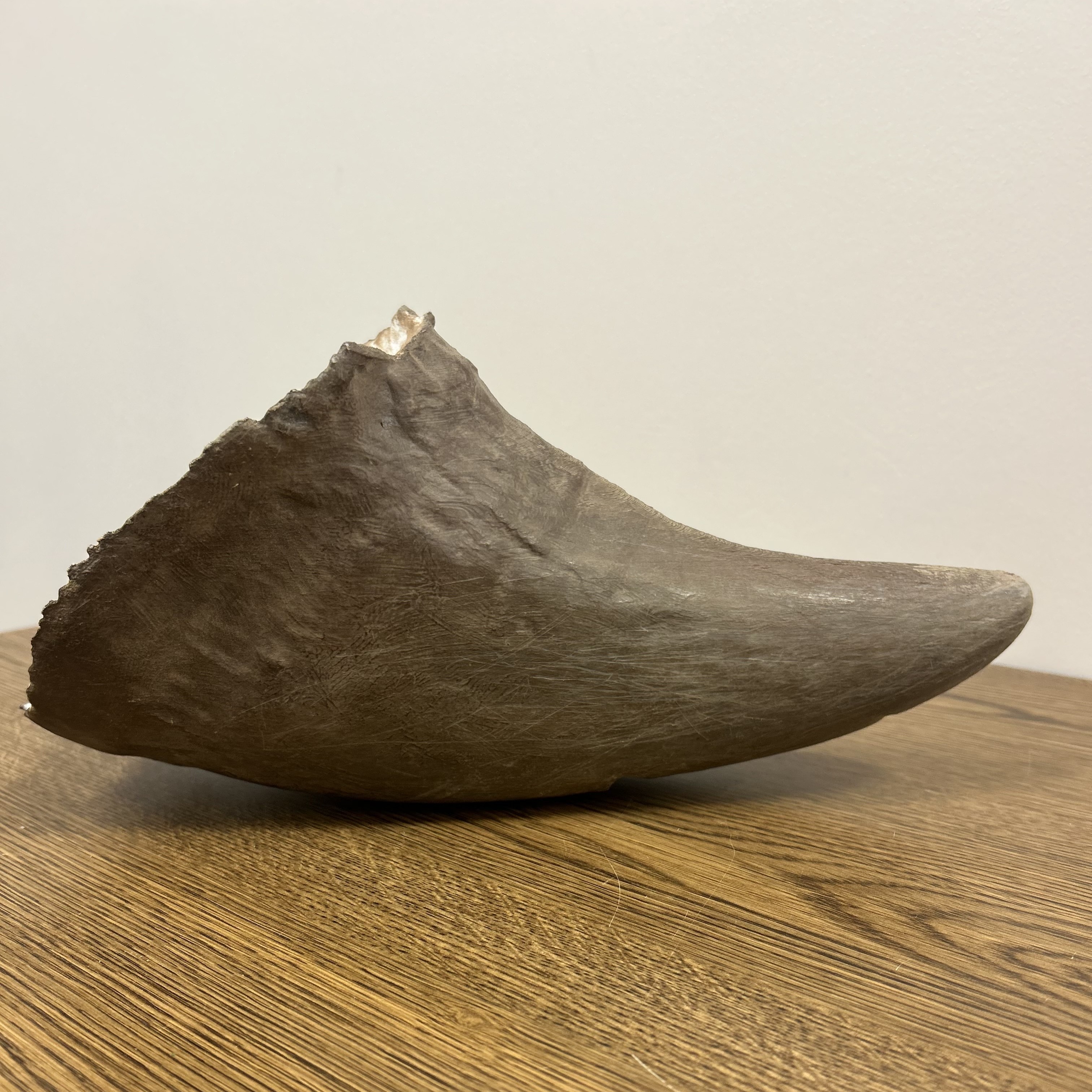
To remedy this, I scaled up the horn. As I mentioned in the last blog post, I used AI to help suggest some dimensions that work. After setting the scale, I sliced the file to produce the G-code for printing. The final G-code and dimensions ( 199.007×112.638×141.600) appear in the picture below.

The result, seen in the photos here, has been one of my most exciting prints to date.


The process took over nine hours to complete, and when it was finally done, Professor Alan Xie kindly painted it for me.


The horn had its public debut when I presented it to my partners from the Wildlife Forensic Academy (WFA), who visited Atlanta for the “Where Forensics Meets the Wild” summit I hosted in September on behalf of the Laker Wildlife Initiative. Dr. Georgio Mosis and Luuk Smolenaers even used it in their summit session to show the power of customized GPTs for identifying wildlife products and then describing proper collection and documentation procedures. Following the summit, it made the journey back to the WFA in South Africa where it is now used as a hands-on tool in their wildlife forensic training simulations. From feedback, I know students have enjoyed working with it and it adds a tangible connection to the real-world challenges of combating wildlife trafficking.

Designing a Bespoke Seahorse with Meshy
While MorphoSource covers thousands of species, there are some species for which no digital file exists. This led me to experiment with creation tools like Meshy, an AI-powered platform for 3D modeling.
One of my favorite recent projects was designing a 3D seahorse. During the same presentation where I learned about the trafficking of shark fins, I also discovered this is true of dried seahorses as well. Dried seahorses are in demand worldwide, especially for use in traditional medicines and as collectibles, making them one of the most heavily traded marine species and a growing conservation concern. I searched MorphoSource for a seahorse, hoping to find a complete model, but the only result was an individual mesh file of a seahorse body and skeleton.
After learning about various online platforms that let you create 3D models using AI—often for free—I decided to give Meshy a try. Meshy lets you generate files in two ways: by uploading an image or by simply telling it what you’d like to create. For my seahorse project, I described that I wanted a dried seahorse that was anatomically correct, and what Meshy produced was pretty incredible—especially considering I only ran a single iteration. You can see the finished product below. This I also gave to Professor Alan Xie for painting before sending it back to the WFA with my partners.

I also experimented with Meshy to create a 3D model of a hawksbill turtle shell. At first, I tried simply telling the AI what I wanted, but this approach wasn’t very effective for such a complex shape. So I switched gears and found some quality reference photos online, which I uploaded to Meshy as inputs. After a few iterations, the AI produced a shell model that looked pretty impressive. You can see it in the video below.
I haven’t printed this one yet—the initial file Meshy generated was way too large for my build plate! In fact, when I open the file I get a warning telling me the object appears to be too large and it asks whether I’d like to scale it down. Rather than spend time rescaling it, I focused on finishing the rest of the shark fins I needed to complete my collection. Nevertheless, I plan to print the shell soon. And while Morphosource doesn’t have just the hawksbill shell, they do include a file for open download of a whole hawksbill turtle.
Blending Open Data and Creativity for Conservation Education
Combining open-access resources like MorphoSource with custom digital design is helping me build a truly rich toolkit for conservation outreach and wildlife crime forensic training. Every new model—whether scanned, sourced, or sculpted—adds to the capabilities of educators and investigators working to fight wildlife trafficking.
I’m still just getting started with my printable specimen library, and there’s much more to come. In future posts, I’ll share more of my experiences, including 3D scanning real specimens, and offer best practices for preparing digital files for hands-on forensic education.
For anyone teaching, researching, or advocating for wildlife, this fusion of digital platforms and 3D printing continues to open exciting new pathways—turning virtual data into something you can hold, study, and share in the service of conservation. Stay tuned!
Leave a Reply