
By Dr. Andrea Allen
For the fourth post in this series, the focus shifts from printers, slicers, and shark fins to something more people‑centered. In this post, the focus is on how 3D printing supports wildlife crime investigations, crime scene training, and related forensic work. Tangible models make abstract ideas concrete, give students and trainees a safe way to handle evidence, and create space for discussion about ethics, uncertainty, and real‑world practice. Studies in science education already show that 3D printed models can improve understanding and engagement, especially when learners can manipulate them directly.
Why Tangible Replicas Matter
Many forensic science and criminal justice courses are often taught with slides, case readings, and perhaps a few preserved specimens or casting exercises. That approach can leave big gaps between theory and what practitioners actually see at scenes or in the lab. 3D printing helps bridge that gap by creating replicas of bones, toolmarks, wounds, or entire miniaturized scenes that students can pick up, rotate, and compare. Unlike original evidence, these replicas can be passed around a classroom without contamination concerns, stored long-term, and remade as technology improves.

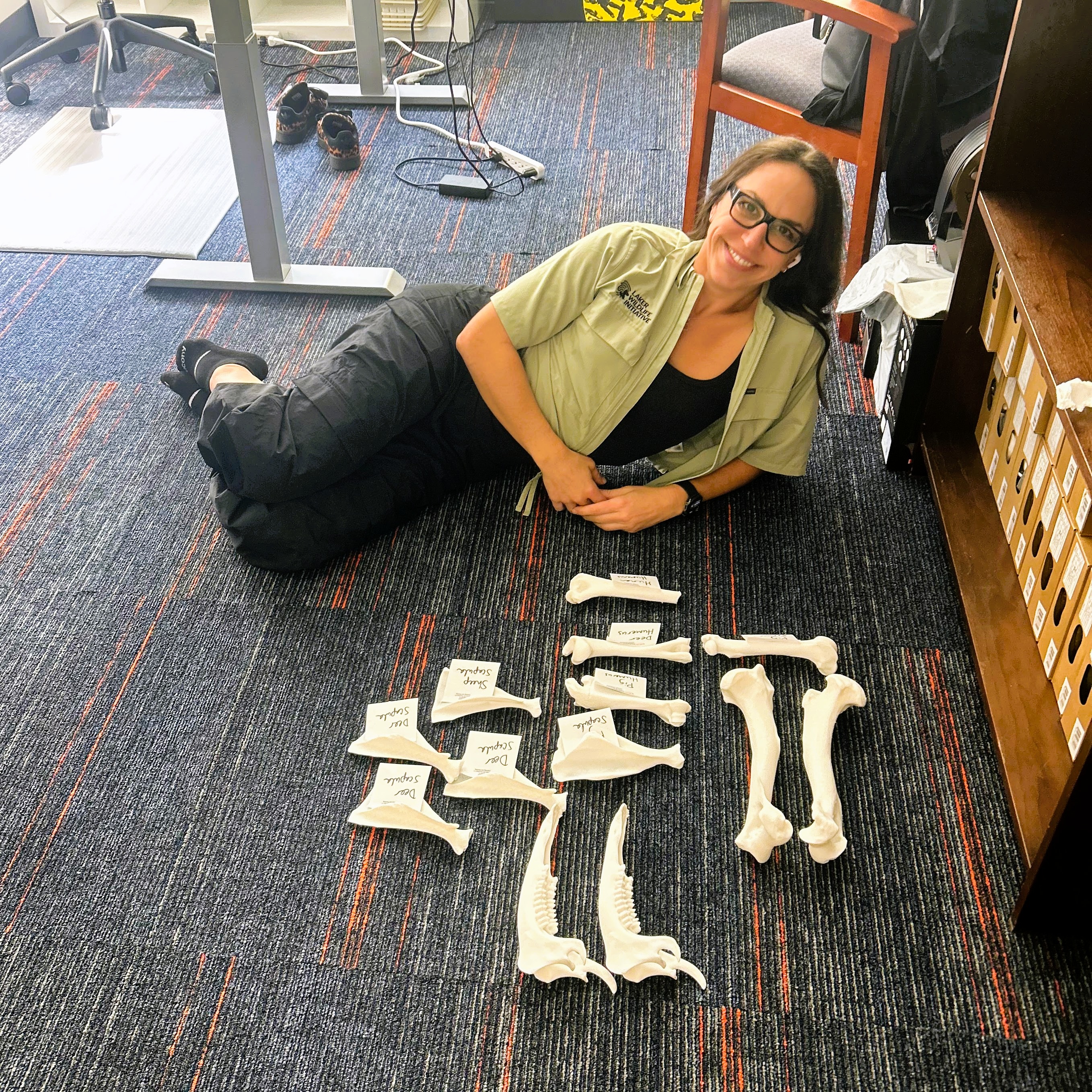
From a pedagogical perspective, 3D printed models support active learning. Instead of just listening to a lecture on fracture patterns or toolmarks, students can examine printed samples side by side and work in small groups to hypothesize what happened. For example, they can examine fracture patterns on long bones (from antelope or deer), cut marks on shark fins, or saw damage on confiscated ivory. Research in broader science education has found that this kind of hands-on interaction with 3D printed models improves conceptual understanding and performance, particularly when students are encouraged to discuss what they see and test their ideas.
From a practical standpoint, 3D printed models are also far more economical than many commercially produced resin casts or proprietary training kits. Filament materials are relatively inexpensive and once a design is created it can be reprinted indefinitely for only the cost of plastic. Furthermore, because the same 3D printers can be used year after year in multiple courses, the upfront hardware cost is spread across many cohorts, making each individual model comparatively inexpensive to produce. This makes it feasible to give every small group — or even every student — their own specimen instead of sharing a single fragile model. Because most classroom prints are made from tough thermoplastics designed for repeated handling, they stand up well to being dropped, packed, and transported, and damaged pieces can be quickly replaced from the original file rather than ordering an entire new set.
Teaching with 3D Prints
In criminal justice and forensic training classrooms, 3D printed replicas can be used across many types of courses. For wildlife crime and ranger training, printed models of bones, horns, or fins can be used to reconstruct poaching or trafficking scenarios and practice evidence collection. And in forensic anthropology and related human‑remains courses, printed skeletal elements with simulated trauma can help students learn to differentiate blunt, sharp, and ballistic injuries, and to link those injuries to potential weapons.


These models also support scenario-based exercises. An instructor might design a small-scale “scene” with printed fragments of bone, a reconstructed room layout, or an anti‑poaching scenario with scattered wildlife bone fragments and a suspected snare or weapon, and ask students to walk through documentation, reconstruction, and interpretation steps.
From Casework to the Classroom
Courts and police services have been early adopters of 3D printing in forensic work. For example, forensic scientists linked to the University of Portsmouth have used 3D imaging and printing to reconstruct burnt human bone fragments into physical models that can be shown to juries, reducing handling of fragile evidence while still allowing clear physical‑fit demonstrations in court. In a separate line of work, 3D imaging and related technologies developed at the University of Warwick have supported hundreds of homicide investigations with high‑resolution reconstructions that help police and courts understand injuries and events across dozens of police forces in the UK and beyond.

3D printed baboon skull for exploring cranial features and species identification in wildlife‑crime scenarios
Even though these projects are driven by casework, the same techniques translate naturally into teaching. In universities and training programs, 3D printed models and reconstructions can be reused as classroom examples, giving students and trainees access to realistic injuries, bone fragments, or tool marks without exposing them to sensitive original evidence. Research from anatomy and biology education also suggests that when learners handle 3D printed models in small‑group activities, they often perform better on assessments and report clearer understanding than peers who only see 2D images or diagrams, which supports using similar strategies in forensic and wildlife‑crime training.
Student and Instructor Feedback
Student feedback on 3D printed models in science education typically highlights three themes: improved understanding, higher engagement, and a stronger sense of connection to real-world practice. Learners often describe printed models as more “real” than diagrams or slides, even when they know they are replicas. The ability to turn an object in their hands, look closely at small features, and compare multiple examples side by side makes it easier to grasp complex spatial relationships and differences between cases.

High‑school students exploring 3D printed wildlife models during an outreach session with the Laker Wildlife Initiative.
Instructors, for their part, value the flexibility and safety that printed models provide. They can design custom teaching collections tailored to specific learning outcomes, such as sets of similar but subtly different injuries or impressions, or wildlife parts that differ by species or legality status. 3D printing also supports more inclusive teaching: models can be scaled up for easier viewing, labeled in accessible ways, or shared with students who cannot access labs in person. At the same time, educators note practical limitations—some models can be fragile, production takes time, and careful guidance is needed to ensure students understand both the power and the limitations of replicas as stand-ins for real evidence.
Looking Ahead
As 3D printing becomes more accessible, educational uses in forensic and investigative sciences, including wildlife crime and conservation, are likely to expand. There is room for collaborative, open collections of de-identified teaching models, shared across institutions and updated as new scanning and printing methods emerge. Integrating these models with AI-driven tools—such as interactive tutorials, automated measurement aids, or virtual companions that prompt students to look more closely at specific features—could further enhance the learning experience.
For now, even a small set of well-chosen 3D printed replicas can change the feel of a forensics focused class. They bring the work closer to what practitioners actually see, give students a safe way to work through evidence step by step, and open up conversations about how evidence is represented in both classrooms and courtrooms. In the next post, this conversation about 3D printed teaching sets continues with a closely related challenge: training people to distinguish human from animal bones using side‑by‑side prints.

Leave a Reply