
By Dr. Andrea Allen
By this point in the series, 3D printing has moved from a curiosity to a working tool in my teaching and wildlife forensics projects. The next step is less about a single printer or model and more about building something that can outlive any one case or course: curated 3D libraries that help people make better decisions in real time, especially in wildlife crime and wildlife–human “border” scenarios.
Why Regional 3D Libraries Matter
My hope is that this blog has shown the value of 3D printing in field identification and forensic training, particularly for distinguishing wildlife from human remains in real-world scenes. Part 5 explored how printed bone kits can support first responders and investigators making rapid human vs. non-human decisions. But that was just the foundation. The next step is less about solving that single problem and more about building systems—specifically, regional 3D libraries designed with intention, not just breadth for its own sake.
The gap isn’t, necessarily, in lacking bones. OsteoID, decision-tree methods, and existing reference collections, such as Morphosource and the Smithsonian’s Taphonomy collection, already help achieve high accuracy. The gap is in the form of what people actually encounter and the context in which they encounter it. Law enforcement and forensic practitioners work within specific geographic and ecological realities. A bone found in a forested park in Georgia triggers a different mental inventory of “likely suspects” than one discovered near a South African game reserve. Domestic dogs and deer dominate one landscape; antelope, livestock, and lions another.

A regional 3D library acknowledges this specificity. Rather than trying to archive every possible bone and variant, these libraries can be curated with purpose and tailored to reality: they will prioritize the bones most likely to be confused with human remains in a particular geography, reflect the conditions specimens are actually found in (weathered, burned, partial), and sit within the ecological and criminal context of that region. This is not a museum approach. It’s a decision-support approach.
Existing Resources and Building On Them
This work doesn’t start from zero. OsteoID is a comprehensive resource that deserves credit: it provides a well‑curated 3D library of 28 species commonly found in the United States (including humans, mammals, birds, and turtles), offers open‑access 3D printing files for those models, and includes a powerful measurement‑filtering tool that allows users to input bone dimensions (length, width, thickness) to narrow down possible species identifications. For someone with anatomical knowledge and access to calibrated measuring tools, OsteoID is invaluable.

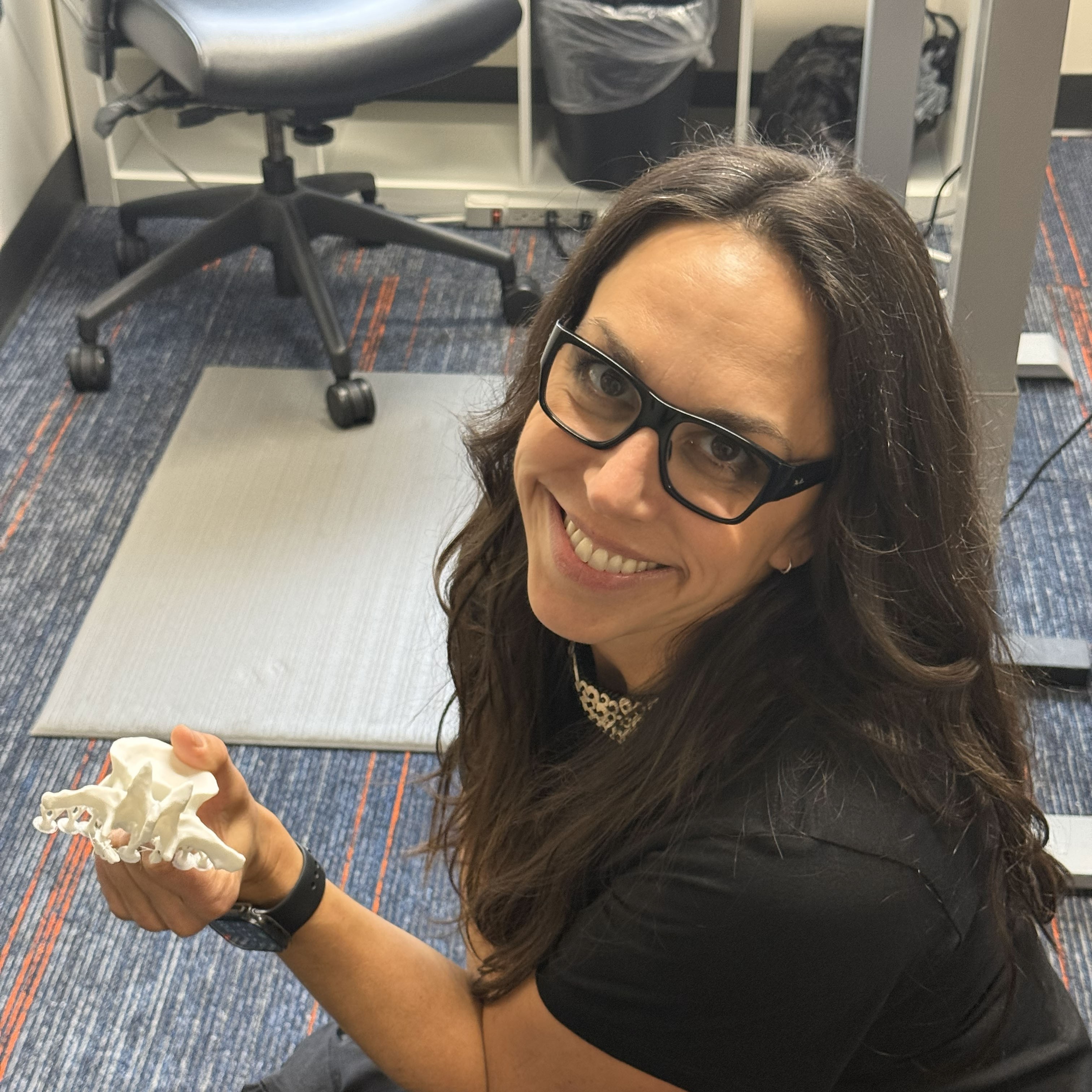
The National Institute of Allergy and Infectious Disease’s NIH 3D project also provides equally important groundwork: a fully articulated and disarticulated human skeleton model, openly licensed and ready to print, which eliminates ethical constraints around handling real human remains in educational settings. The pictures directly below show me taking a set of cervical bones from this project out of the 3D printer.


Yet here’s the key reality: even excellent tools like OsteoID require foundational knowledge to use effectively. While OsteoID does include resources about measurement techniques and morphological interpretation, translating that digital knowledge into confident field decisions is a different skill—especially for first responders, rangers, customs officers, or law enforcement professionals who may not have deep anatomical training. The gap isn’t in OsteoID’s quality; it’s in the translation from “I have data” to “I’m confident in my call.” Tactile, printed references that can be handled and compared directly to unknown specimens help close that gap.
And even with OsteoID’s and Morphosource’s files and the NIH 3D skeleton, none directly addresses the specific challenge that wildlife forensic professionals and customs officials face: recognizing processed, modified, and trafficked forms of wildlife—dried marine products, carved items, cut bone, tanned leather—or the regional variations in preparation techniques. The gaps are twofold: there is still no truly comprehensive, open database of trafficked wildlife bones and products, and there is a persistent gap in turning scattered digital resources into embodied, field-ready recognition skills.
Building regional 3D libraries means starting with these established resources and then extending them intentionally toward the trafficking and forensic‑education applications they do not yet cover. This is where curated 3D‑printed kits fill a critical gap. Holding a three‑dimensional model in your hand—turning it to see every angle, comparing it directly against an unknown specimen—provides a type of learning that digital tools and measurement systems cannot replicate. A customs official scanning a bone fragment at a port needs more than access to Morphosource and OsteoID and a set of calipers; they need tactile, immediate reference materials that build familiarity through repeated handling. Perhaps, a ranger in the field needs something portable and practical, a physical reference they can carry and consult without a computer connection or advanced anatomical training. Regional 3D libraries built on this principle—combining the rigor of OsteoID with the accessibility of printed, handled objects—help close that gap between information and confidence.

Designing Libraries for Real Decisions
Now that we’ve established the need for regional specificity, the question becomes how to actually build libraries that match what people do on the ground. The point is not to invent a completely new source from scratch, but to blend what already exists—and then add to it by filling gaps with new 3D scans of the bones and products we actually encounter in the field—into focused libraries that serve specific people in specific places.
Three principles guide what goes into these libraries—and what you intentionally leave out:
- Commonly confused elements: Long bones, vertebrae, and skull fragments from animals like deer, pigs, cattle, or large reptiles that can mimic human size or shape at a glance.
- Relevant scales and conditions: Prints that reflect what people actually find: whole bones, yes, but also partial, weathered, or burned fragments.
- Region and role: Sets that reflect local fauna and the typical questions different practitioners face—for example, a Georgia patrol officer sorting human vs. common local wildlife, a ranger distinguishing antelope, livestock, and large carnivores near a protected area in Africa, or a customs agent comparing processed products from high‑risk traded species at an airport.

In practice, a regional 3D library takes tools like OsteoID, museum scans, and teaching skeletons and reshapes them into an accessible digital library and, where possible, a small set of tangible 3D‑printed kits that match those local questions, rather than asking each first responder or customs officer to navigate multiple databases on their own.
Where These 3D Libraries Go Next
The work of curating regional 3D libraries and printing new teaching skeletons is still very much in progress, but the direction is clear: building sustained, sharable resources that help people make better decisions in wildlife and forensic contexts. Beyond these regional bone libraries, the same 3D printing and scanning principles extend to a broader challenge in wildlife forensics: building a digital repository of trafficked wildlife products that captures the regional and morphological variety of trafficking routes.
As these libraries grow, they will not replace expert judgment or field experience. Instead, they offer another set of tools—in plastic and pixels—that can sit alongside decision trees, databases, and lived knowledge. The hope is that, in the hands of first responders, students, and investigators, those tools will help bring clarity a little faster, and open the door for better outcomes in both human and wildlife forensics.


Leave a Reply